
Executive Summary
Most leadership teams assume that the greatest execution risks emerge when performance starts to deteriorate…
Sales slow.
Margins come under pressure.
Forecasts become less reliable.
Customers become harder to win and retain.
In response, organisations become more attentive. Reporting is scrutinised more closely, assumptions are challenged, and leadership teams spend more time understanding what is happening and why.
Yet in our experience, the opposite is often true.
The most dangerous period is frequently when results are improving, confidence is high and everyone believes the business is on the right track.
Not because growth is dangerous.
But because growth creates complexity.
As markets, customers and channels evolve at different speeds, organisations often become more successful while simultaneously becoming harder to understand.
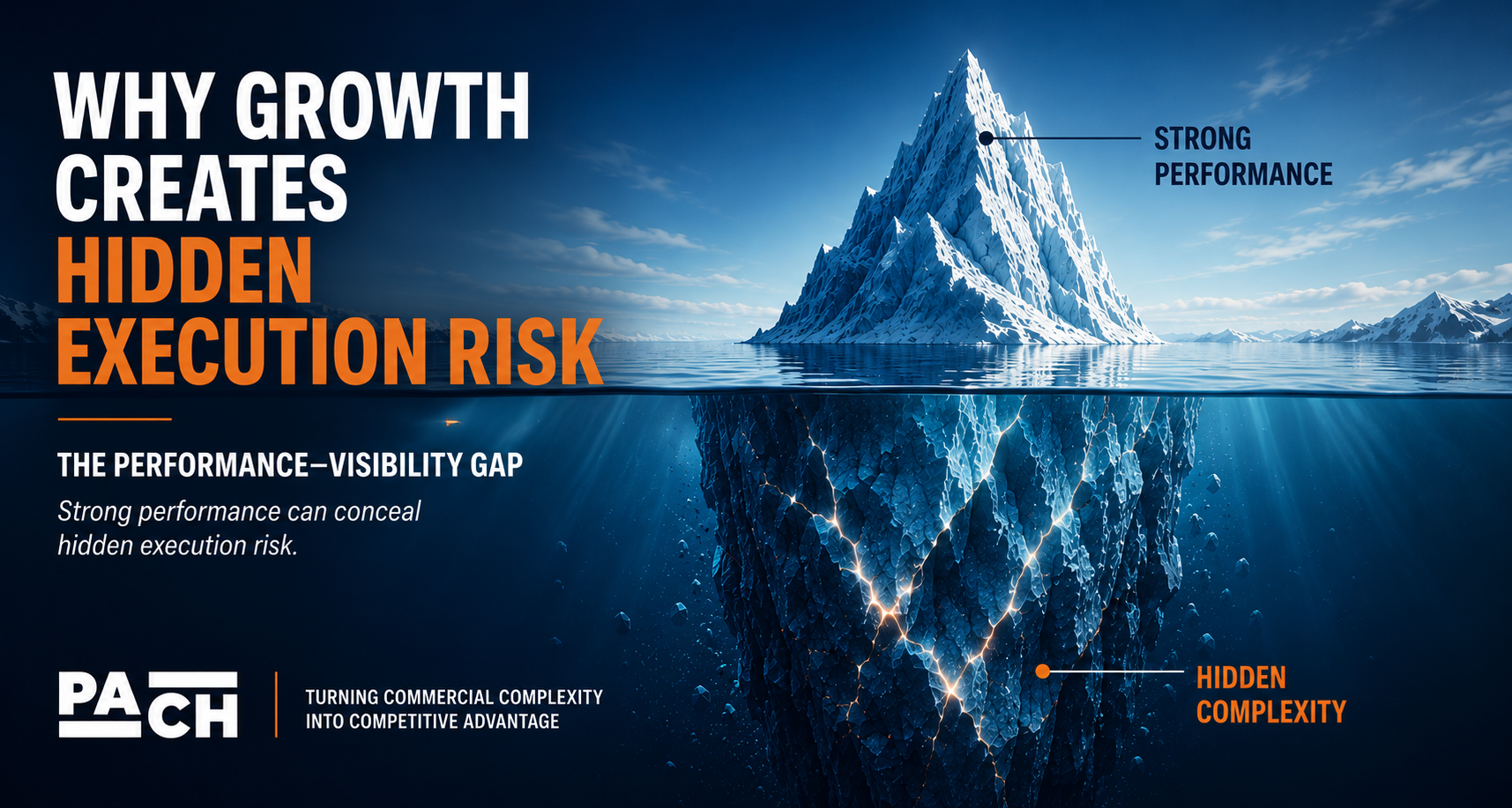
Performance improves…Complexity increases…Visibility declines…Leadership confidence remains high.
This creates what we refer to as the Performance - Visibility Gap, a period where performance remains strong, but visibility into what is actually driving that performance begins to deteriorate.
The strongest businesses recognise this risk early. Rather than waiting for performance problems to emerge, they actively seek to understand how their commercial system is evolving while results are still healthy.
Why Decline Improves Visibility
When performance comes under pressure, organisations are forced to confront reality.
Leadership teams ask tougher questions. Market visits increase. Functional silos become less important as everyone focuses on understanding the source of the problem. Forecasts are challenged, customer relationships are examined more closely and assumptions that may have gone unquestioned for years suddenly come under scrutiny.
This heightened level of curiosity often creates a surprisingly clear view of the business.
The organisation becomes more aware of what is happening because it has little choice. Weaknesses that may have existed for years are exposed by deteriorating performance, and the resulting pressure forces leaders to understand the underlying causes.
In many respects, struggling businesses often understand themselves remarkably well. They know where the problems are, which customers are underperforming, where execution is inconsistent and which parts of the organisation require attention.
The challenge is that visibility is frequently mistaken for performance. Leaders assume that because results are poor, execution risk must be high. In reality, declining performance often creates the conditions for stronger visibility and faster learning.
Key Observation
Declining performance forces organisations to confront reality. Growth often allows assumptions to survive unchallenged.
Why Growth Creates Complexity
Growth is generally viewed as evidence that a strategy is working…
Markets recover.
Customers buy more.
Volumes increase.
New opportunities emerge.
Confidence grows and attention naturally shifts towards the future.
The difficulty is that growth rarely unfolds in a consistent manner. Different markets recover at different speeds. Customer behaviour evolves differently across channels. Competitive intensity varies by geography. Local teams adapt to local circumstances and route-to-market structures continue to evolve.
Growth creates complexity because:
Markets recover at different speeds.
Channels develop their own dynamics.
Customer behaviour changes unevenly.
Local adaptations multiply over time.
Individually, these changes are manageable. Collectively, they make performance significantly harder to interpret.
One market may achieve growth through pricing discipline. Another through promotional investment. A third through improved distribution. A fourth through a different customer mix. Each explanation is entirely reasonable when viewed in isolation.
The challenge for leadership is understanding what is truly driving performance across the organisation as a whole.
The further an organisation moves into recovery and growth, the harder this question often becomes to answer.
The Performance–Visibility Gap
The Performance - Visibility Gap occurs when performance improves faster than an organisation's ability to understand what is driving it.
The business appears healthier…Visibility deteriorates…Leadership confidence remains high. Counterintuitively, the period of strongest performance may also be the period of lowest organisational visibility. This creates a paradox for leadership teams.
As performance improves, scrutiny naturally reduces. Markets are granted greater autonomy. New initiatives are layered onto existing activities. Local exceptions become more common and reporting becomes more complicated as the organisation attempts to reflect an increasingly diverse set of realities.
None of these developments are inherently negative. Many are a natural consequence of growth. However, together they create the conditions for visibility to decline.
Where Visibility Is Usually Lost First
One of the most interesting characteristics of the Performance–Visibility Gap is that visibility rarely disappears everywhere at the same time.
In fact, the first signs of growing complexity are often visible to the people closest to customers long before they become visible in management reports.
Sales teams notice changing buying behaviour.
Distributors observe shifts in demand patterns.
Customer-facing teams see channels evolving in different ways.
Market leaders recognise when local adaptations are beginning to diverge from established ways of working. The challenge is not that these insights do not exist. The challenge is ensuring they are captured, shared and acted upon before complexity becomes embedded in the system.
By the time divergence becomes visible in headline KPIs, it has often been visible to frontline teams for months. The strongest organisations therefore treat frontline insight as an early-warning system, not simply a reporting mechanism.
What Makes This Dangerous?
Results remain strong.
Confidence remains high.
Local exceptions increase.
Understanding becomes fragmented.
The danger is not that performance deteriorates. The danger is that leadership gradually loses sight of the mechanisms that are creating performance in the first place.
What We Have Observed
The pattern becomes clearer when viewed across multiple businesses. While the circumstances differed significantly, all three organisations had something important in common:
None of them were underperforming.
Case Study 1: Future-Proofing a Strong Business
Situation
A successful food and beverage business operating in one of Europe's most developed out-of-home markets.
Question
"What are we future-proofing against?"
What We Found
Customer buying behaviour was changing. Channel boundaries were becoming increasingly blurred. Alternative supply routes were influencing pricing and commercial complexity was growing. Promotional investment was increasingly being used to defend volume rather than create growth.
Key Lesson
Strong performance had not removed risk. It had simply made risk harder to see.
Case Study 2: The Market-Leader Health Check
Situation
A market-leading alcohol beverage business seeking an independent assessment of its commercial health.
Question
"How healthy is the commercial system beneath the results?"
What We Found
The review identified weaknesses in planning, forecasting, route-to-market execution, sales capability development and customer engagement. Most of these issues had not yet become visible in the headline performance numbers.
Key Lesson
The issues existed long before they appeared in the results.
Case Study 3: Similar Results, Different Models
Situation
A European beverage company delivering successful growth across multiple countries.
Question
"Are markets succeeding for the same reasons?"
What We Found
Different markets were achieving similar results through very different commercial models. Coverage strategies differed, route-to-market structures differed and customer engagement approaches differed. While performance appeared consistent, the drivers of that performance varied significantly across markets.
The issue was not whether the markets were performing.
The issue was whether the business could continue to perform as complexity increased.
Key Lesson
Performance looked consistent. Execution was not. The company returned to revisit a related question through a broader review of what its sales organisation should look like 10 years hence.
Performance had not exposed the issue.
Complexity had.
Five Warning Signs
Across food, beverage and consumer goods businesses, we repeatedly see five signals that visibility may be declining faster than performance is improving.
1. Different Markets Tell Different Stories
Every market can explain its performance, but the explanations no longer fit together into a coherent regional narrative.
2. Sell-In, Sell-Out and Inventory Tell Different Stories
Shipments appear healthy.
Consumer demand suggests something different.
Inventory movements suggest something else again.
The organisation lacks a single version of reality.
3. Channels Move at Different Speeds
Retail, hospitality, e-commerce, wholesalers and other channels increasingly operate according to different dynamics. Success in one channel can easily mask weakness elsewhere.
4. Local Exceptions Multiply
More decisions become market-specific.
Each exception appears reasonable.
Collectively they reduce consistency, comparability and visibility.
5. Activity Increases Faster Than Clarity
The organisation becomes busier.
More initiatives.
More reporting.
More meetings.
Yet confidence in understanding what is truly driving performance does not improve at the same pace.
The Question Leaders Should Be Asking
Most organisations assume that visibility comes from better reporting.
In our experience, visibility comes from understanding.
Understanding how markets differ.
Understanding how customers are changing.
Understanding what frontline teams are seeing.
And understanding which local adaptations are strengthening performance and which are quietly increasing complexity.
The question for leadership is therefore not simply:
"Are we growing?"
It is:
"Do we understand why we are growing?"
Because when markets, customers and channels begin moving at different speeds, visibility becomes a competitive advantage.
And in many cases, the businesses that sustain growth longest are not those growing fastest.
They are those that continue to understand their business best as they grow.